
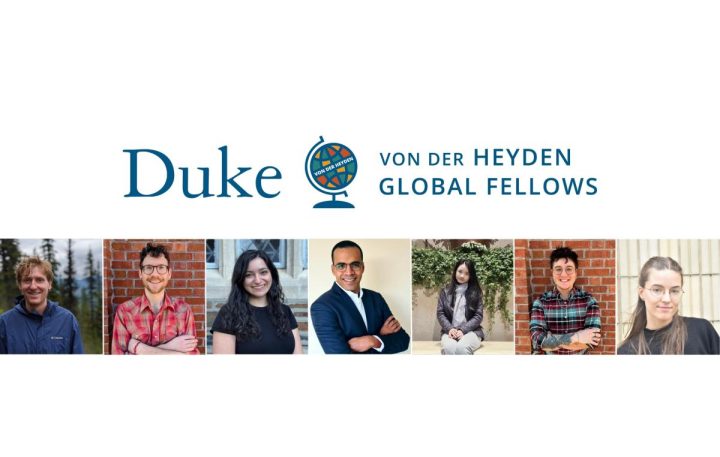
PhD Student Fellowship
Cultivating a new generation of global scholars

Applications for the 2027–2028 fellowship now open. Deadline is January 6, 2027. Applicants must be in their fourth year or later of their doctoral program.
Apply here.
The von der Heyden Global Fellowship (vdH Fellows) is a prestigious opportunity designed to support advanced Duke PhD students who are deeply engaged in research that bridges international or regional studies with critical issues of racial, social, and equitable justice. Eligible applicants are those who have successfully completed their preliminary exams and fieldwork, positioning them to fully dedicate themselves to their dissertation research. This fellowship provides comprehensive financial support for a full twelve months, allowing fellows the freedom to immerse themselves in their scholarly pursuits. In addition to financial backing, the fellowship offers a dynamic cohort experience and valuable professional development opportunities, fostering an environment where intellectual exchange and collaborative growth can thrive.
vdH Fellows will join a diverse, interdisciplinary community of researchers, each bringing unique regional insights and disciplinary perspectives to the table. Together, they will consider how to make a difference regarding global inequalities.
Through collective discussions and individual research, fellows will explore potential pathways to dismantle these barriers and foster a more just and equitable world. Key themes of exploration may include the moral and practical dimensions of global responsibility, strategies for redistribution of resources and power, the importance of meaningful participation and representation, and the mechanisms of empowerment and social transformation. The fellowship encourages scholars to grapple with pressing questions: What do we owe one another as global citizens? How can historical injustices be meaningfully addressed? And what role can scholars play in envisioning and enacting a more just future?
Ultimately, the von der Heyden Global Fellowship aims to cultivate a new generation of scholars whose work not only advances academic knowledge but also contributes to real-world change.
This fellowship particularly intrigued me because it involves an interdisciplinary cohort I can learn from and which I am sure will greatly expand the scope of my dissertation project. I am also excited about the opportunity to learn important skills for building a sustainable community in academia.
-Theresa Sambruno Spannhoff,
PhD student in German Studies (25-26 vdH Fellow)
The von der Heyden Fellows program is supported by a generous endowment from Duke Trustee Emeritus Karl von der Heyden ’62 and his wife, Mary Ellen P’87. In this oral history interview, Karl von der Heyden talks about his life experiences, values, career, and his lifelong commitment to Duke.
Faculty Director

Marcos A. Rangel
Associate Professor in the Sanford School of Public Policy
Marcos A. Rangel is an Associate Professor at Duke University’s Sanford School of Public Policy, with a secondary appointment in the Department of Economics. His research rests on a simple premise: economics is the study of choice, not of money. He examines the decisions families make under scarcity, including how parents allocate resources among their children, how discrimination and others’ expectations shape the returns to and investments in schooling, and how environmental, economic and health shocks reshape fertility and outcomes at birth. His work draws on evidence from Latin America, Southeast Asia, West Africa and the United States. His work appears in Demography, the Review of Economics and Statistics, PNAS, the Journal of Public Economics, the Economic Journal and the American Economic Journal: Applied Economics, among others. He currently serves as co-Editor-in-Chief of Demography and Associate Editor of the Journal of Development Economics, and is affiliated with J-PAL, BREAD, and Duke’s Population and Global Health centers.
Marcos holds a Ph.D. in Economics from UCLA. Before joining Duke, he taught at the University of Chicago, the University of São Paulo, and Princeton University. His research has been recognized with the Royal Economic Society’s Article of the Year Award and the Haralambos Simeonidis Prize for the best article by a Brazilian economist, and his work with students with Duke’s Dean’s Award for Excellence in Mentoring and the Richard A. Stubbing Award for Graduate Teaching and Mentoring.